


Email | LiveJournal | MySpace | Last FM


Offset Festival - Day 2
Bands in order of appearance:
| Official
Secrets Act Eve Black/Eve White Toy Toy Maria And The Mirrors O Children The Ruling Class |
Electricity
In Our Homes The Violets Neils Children Ipso Facto Gang Of Four |
 Hainault
Forest, London
Hainault
Forest, London
Sunday August 31 2008
Sunday isn't quite so sunny, and the Offset Festival takes a while to wake up. The early bands today have the interesting task of playing to the half-asleep and the hungover, but Official Secrets Act are clearly intent on giving it some indie energy on the main stage. Fresh in from my trip on the Central Line, I'm innocently walking across the field at what is clearly grand finale time for the band's set. As I pass by, the vocalist jumps from the stage, leaps the barrier, accosts the bemused and bleary-eyed early risers in the audience, and then scrambles back on stage just in time for the band to bring their final song to a big finish. Nice timing there, lads, but I'm on my way to the Experimental Circle Club tent, which today seems to be the location of most of the interesting stuff.
It's certainly the location of Eve Black/Eve White, who have attracted an impressively large crowd for such an early slot. The Eves' spooked, soulful, after-dark electro seems a little incongruous in a tent at breakfast time – but then again, there's a certain morning-after feel to the music which works rather well, and certainly seems to strike a chord in the woozy heads of a festival audience who are blearily reflecting that last night's enthusiastic lager consumption probably wasn't such a great idea. Not that I'm speaking from personal experience there at all, you understand.
 Although
today looks like it'll mostly be an Experimental Circle day for me, there's
enough time to duck into the New Bands tent to see what's up. And, as
it happens, Toy Toy are what's up.
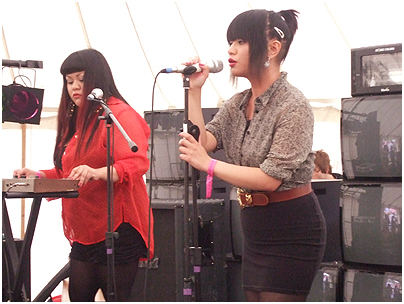
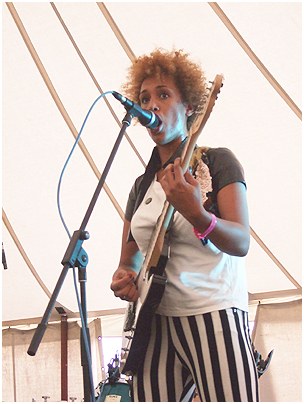
Coming on like the long lost London cousins of the Rezillos, Toy Toy are
a duo-plus-drummer outfit who play spiky pop that fizzes like carelessly
handled fireworks and clatters electronically like vintage computer games
on overdrive. There's a certain punk attitude in there too: Toy Toy aren't
afraid to put a bit of strop in their pop. The guitarist fires six-string
splinters and lyrical squibs at the audience, while over on her right,
in the electroncs-generation zone, the keyboard player conjurs sweeps
and fuzzes and blips out of the air. The result is a gleeful sonic riot
that maintains a certain jerky discipline even as it's kicking over the
furniture and scribbling on the walls with day-glo crayon. Quite an experience
at this early hour of the day. Toy Toy are a bit like drinking fizzy pop
for breakfast, and then realising, once you're half way down the glass,
that there's a hefty slug of vodka in there too.
Although
today looks like it'll mostly be an Experimental Circle day for me, there's
enough time to duck into the New Bands tent to see what's up. And, as
it happens, Toy Toy are what's up.
Coming on like the long lost London cousins of the Rezillos, Toy Toy are
a duo-plus-drummer outfit who play spiky pop that fizzes like carelessly
handled fireworks and clatters electronically like vintage computer games
on overdrive. There's a certain punk attitude in there too: Toy Toy aren't
afraid to put a bit of strop in their pop. The guitarist fires six-string
splinters and lyrical squibs at the audience, while over on her right,
in the electroncs-generation zone, the keyboard player conjurs sweeps
and fuzzes and blips out of the air. The result is a gleeful sonic riot
that maintains a certain jerky discipline even as it's kicking over the
furniture and scribbling on the walls with day-glo crayon. Quite an experience
at this early hour of the day. Toy Toy are a bit like drinking fizzy pop
for breakfast, and then realising, once you're half way down the glass,
that there's a hefty slug of vodka in there too.
With nothing to go on but the name, I'd assumed that Maria And The Mirrors would be some sort of 80s-influenced pop group, bouncing amiably around the retropop landscape somewhere between Martha And The Muffins, Tracy Ullman and Kirsty McColl. Because...well, that's what their name sounds like, doesn't it? But names can be deceptive. Maria and the Mirrors aren't like that at all. In fact, the band resembles some sort of post-apocalypse urban tribal-trash future. When our consumer society finally falls to bits, and we're scrabbling through the ruins of the supermarket for the last tin of economy beans, this will be the music being piped through the speakers in the ceiling. Two girls in tinfoil dresses stand opposite each other and hammer away at deconstructed drum kits (these must be the Mirrors) while, in the middle, a bass-bloke connects the beats in the bottom end (presumably, he's Maria). One of the mirrors supplies vocal punctuation, and the resulting rhythmic, tumbling noise is at once exhilarating while being gloriously un-rock 'n' roll. Maria And the Mirrors don't deal overmuch in melodies – in their world, rhythm is king and the beat is the thing – but the band's heady rush and rumble does the job.
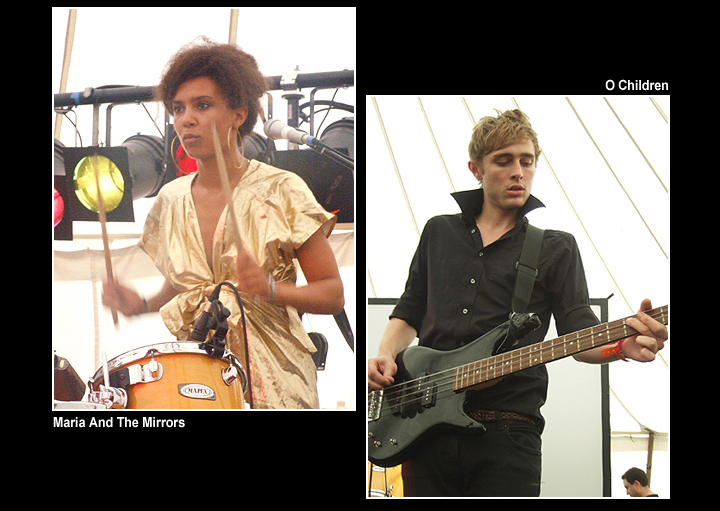 |
Call me foolish if you will, but I was rather disappointed when I discovered that the name of O Children is intended to be pronounced 'Oh children' rather than 'Zero children'. Somehow the correct version sounds...well, a bit weaker, don't you think? I thought they were making a point, taking a stand: in fact, they're just being a bit flowery in their language. O Children are not, however, the slightest bit floral in other aspects of their art. They're dressed in resolute monochrome, and the music is monochrome, too: a kind of only-just-post Joy Division rumble in which the singer (who is wearing the skinniest pair of drainpipes I have ever seen) pits his sepulchral vocal against a no-frills new wave noise. And yes, it is very, very Joy Division, although without the overarching feeling of forboding, or indeed the tough, wired dynamic of the original. I fear O Children are one of those bands that can't quite get out from under the shadow of their obvious primary influence. I can't help feeling that O Children are a thin veneer over chipboard, to Joy Division's solid hardwood plank.
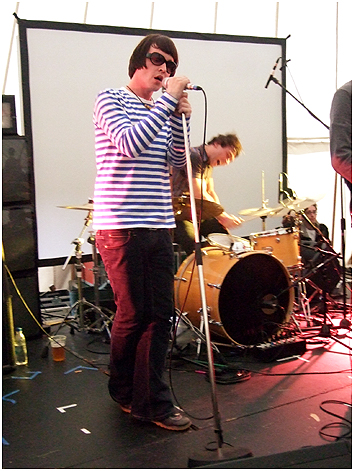 At
a festival largely based around music influenced by the early 80s new
wave, it's a slight surprise to come upon a band like The
Ruling Class, who are clearly in thrall to the ravetastic Madchester
vibe of the early 90s. They're dressed in the studied casualwear of the
era – yes, including the essential baggy jeans with shamelessly extravagant
flares. And they're playing a kind of blissed-out trance-pop that pitches
itself equidistant between The Stone Roses at their most stoned and imacculate,
and Primal Scream at their most indie-dance. In truth, The Ruling Class
are good at what they do; they're clearly genuine enthusiasts for their
musical era, and they reproduce the groovy dance-rock stylings of the
time with great aplomb. In any case, it would be churlish of me to dismiss
their attempts to drag the sounds and styles of the early 90s into the
present day, when that's exactly what many other bands at the Offset Festival
are trying to do with the sounds and styles of the early 80s. But I approach
all this with a certain wariness, just as I approached the original inhabitants
of this musical area with caution.
At
a festival largely based around music influenced by the early 80s new
wave, it's a slight surprise to come upon a band like The
Ruling Class, who are clearly in thrall to the ravetastic Madchester
vibe of the early 90s. They're dressed in the studied casualwear of the
era – yes, including the essential baggy jeans with shamelessly extravagant
flares. And they're playing a kind of blissed-out trance-pop that pitches
itself equidistant between The Stone Roses at their most stoned and imacculate,
and Primal Scream at their most indie-dance. In truth, The Ruling Class
are good at what they do; they're clearly genuine enthusiasts for their
musical era, and they reproduce the groovy dance-rock stylings of the
time with great aplomb. In any case, it would be churlish of me to dismiss
their attempts to drag the sounds and styles of the early 90s into the
present day, when that's exactly what many other bands at the Offset Festival
are trying to do with the sounds and styles of the early 80s. But I approach
all this with a certain wariness, just as I approached the original inhabitants
of this musical area with caution.
I liked the musical landscape of the early 80s, and the feeling that a rising tide of underground creativity – stroppy, fractious, and bristling with attitude - was about to flood the mainstream, the feeling that the misfits and the mavericks, in their bedrooms and their attics, were creating something rooted in reality that would confront that reality, and maybe, just maybe, change it. More of that in the here and now would be a very good thing, if you ask me. But the pilled-up-and-party hedonism of the 90s rubbed me up the wrong way, and too many of the people involved seemed like neo-hippies who'd been a bit too quick to embrace happy drugs, designer brands, and rampant Thatcherism. Good as they are at doing their stuff, I don't want to join the Ruling Class on the 90s trance-dance floor. I'll take the death disco any day.
Electricity In Our Homes aren't exactly largeing it on the floor of the Death Disco: they're more like the sensible kids, hanging around the entrance, allowing themselves a judicious bout of recreation before heading home early to do their homework. Apparently, the band's vocalist recently quit, so the incarnation of Electricity In Our Homes on stage right now is a hastily re-jigged version in which the vocals are shared out between bassist and guitarist. The guitar skitters frantically, the rhythms rush around like excitable small animals in a cage, vocals square up to each other and collide. Paradoxically, the frantic rush of the music is not matched by the demeanour of the musicians: both guitarist and bassist stand at their respective microphones throughout, exuding restrained common sense even as the music they're playing freaks out like Frank Zappa beating up the Buzzcocks. But it's still a cool experience: the band's oddly-shaped freakisms balance neatly between interestingly weird and reassuringly accessible, and there's a choppy, cerebral charm at work in the music which strikes its own spark.
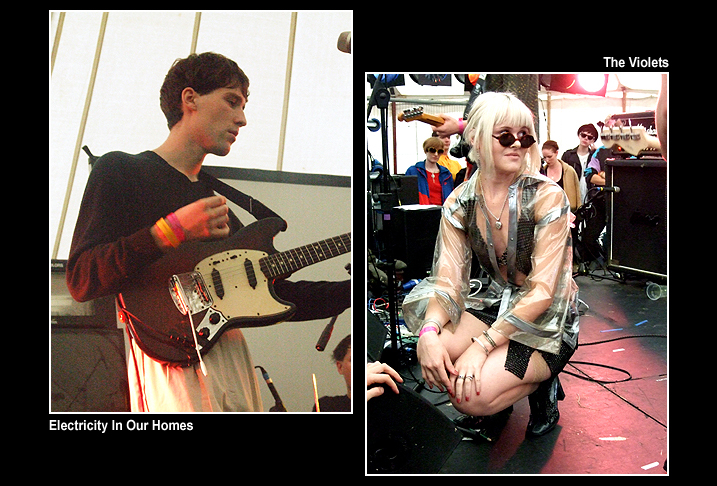 |
Dressed like she's just come back from a shopping trip to Biba, circa 1969, Alexis, vocalist with The Violets, cuts a bohemian figure amid the bedraggled festival hordes. And a surprise: instead of pitching straight in to their splintered-ice post-punkisms, The Violets begin with a take on Jaques Brel's anthem of woe, 'Amsterdam'. It's easy to pitch this song wrong - see the Dresden Dolls' unfeasibly cheery version as a handy example of how not to do it - but The Violets get it right, giving the song just the right mix of defiance and desolation. And then it's straight in to those splintered-ice post-punkisms - hear the way 'Descend' turns the guitar-noise on and off, as if someone's flicked a switch - and not for the first time I'm reminded that getting it right is what The Violets do. Walking the invisible tightrope between release and control, fire in the belly and ice cream on the tongue all at once, The Violets pull strange energy out of the air in a way few other bands I've seen can match, and they do it without any grandstanding or rock histrionics (quite the reverse: the bassist barely faces the audience). Aside from Alex in her surrealist rainwear the band are self-effacing and resolutely dressed down, and that's all they have to be. Alex carries the show; the music does the work.
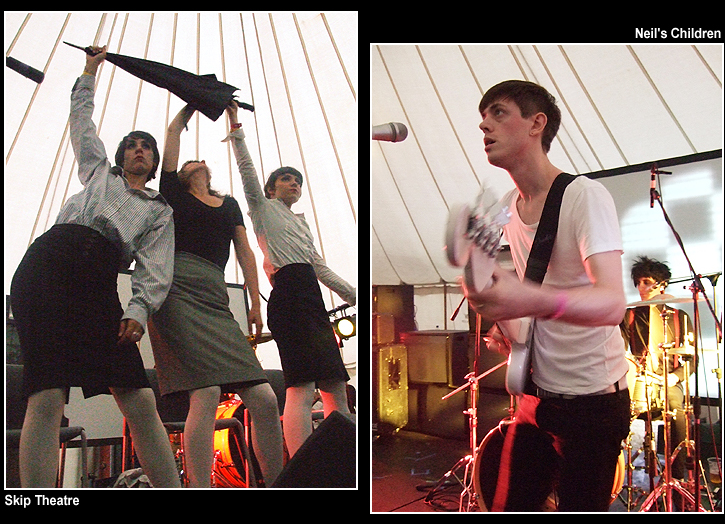
All of a sudden, there are three women on stage, brandishing newspapers and umbrellas with an air of stony-faced purpose that is entirely undiminished by the fact that nobody in the crowd quite knows what's going on. This is Skip Theatre, a performance art group whose purpose is to take art to the masses, whether the masses want it or not. Here, they've incorporated some of that performance art into a set by Neils Children (No typo: the band really have dropped their apstrophe - the grammatical equivalent of deliberately playing a bum note, in my view, but you just can't tell these kids, can you?)
After the bout of umbrella-brandishing, the band come on and the rock 'n' roll begins. Neils Children are a somewhat more sophisticated proposition these days, compared to their earlier incarnation as a kind of garage-punk version of The Cure. Now, they power through their songs with disciplined economy and a certain air of economical cool. They're a very twenty-first century band, in a way: picking up on reference points from alternative music's murky past, and stripping it all down to a purposeful, pulsing, Robert Smith-meets-the-Smiths inflected soundtrack. It's indie-jangle for the twenty-first century - 'I'm Ill' is typical, all jang-a-jang guitar and angst-in-the-bedroom vocals - and although it all follows the classic indie blueprint pretty closely, it's done rather well. The Skip Theatre crew re-appear, this time rocking leotards and hula hoops, and the contrast between the band's no-nonsense demeanour and the wayward surrealism of the theatrics makes for a suitably fantastical finale.
 |
Reserved,
deadpan, all bobbed hair and aloof demeanour, Ipso
Facto look like a pop group designed by Aubrey Beardsley. They
survey the crowd with appraising glances, the ladies of the house sizing
up applicants for the post of chambermaid. And then, with no fuss or rock
'n' roll posturing – perish the thought – it's away into the
frostily enticing churn and crackle of the music. Ipso Facto's songs are
like buttoned-up blouses, all prim and proper and yet pulsating with an
inner life. Their music manages to be assertive without ever being gratuitously
aggressive, detailed and nuanced without 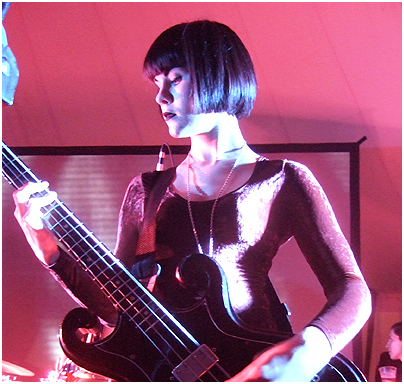 ever
being cluttered or overblown. They seem oddly at home on this ramshackle
stage, in this crowded tent, and yet I bet they'd exude the same unrulled
calm and implacable charm under any circumstances. Ipso Facto are cooler
than the inside of the fridge in your kitchen, while also somehow thrumming
with the hidden heat of the furnace in the basement. They're like a band
of artist's muses who seized control of the art for themselves, and their
quietly implacable persona – here they stand, they can do no other
– is easily the equal of any bunch of rock 'n' roll roaring boys.
ever
being cluttered or overblown. They seem oddly at home on this ramshackle
stage, in this crowded tent, and yet I bet they'd exude the same unrulled
calm and implacable charm under any circumstances. Ipso Facto are cooler
than the inside of the fridge in your kitchen, while also somehow thrumming
with the hidden heat of the furnace in the basement. They're like a band
of artist's muses who seized control of the art for themselves, and their
quietly implacable persona – here they stand, they can do no other
– is easily the equal of any bunch of rock 'n' roll roaring boys.
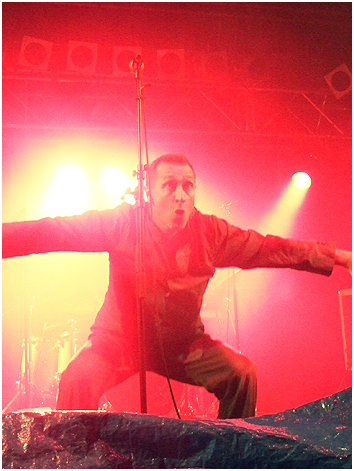
Across wet grass to the main stage, and by now, it's dark and raining – and I wonder how many times the Gang Of Four (who surely must be old hands at this festival lark by now) have faced similar circumstances. The rain billows straight into the stage, but the Gang aren't about to slack off. As a matter of detail, this is a new version of the band. Dave Allen on bass and Hugo Burnham on drums have now vanished back to their other lives after the conclusion of the band's 'original line-up' tours. Now Andy Gill, on vocals, microwave-smashing, and faintly disturbing on-stage freak-outs, and Jon King, on guitar and menacing stare, are now joined by a new bassist and drummer. It's not the first time the band has operated on a kind of Gang-Of-Two-Plus-Two line-up, and it must be said that some of the earlier incarnations of this type were rather less than astounding. But tonight, in the gusting rain, the revised Gang pull a good one out of the hat, and prove that they've still got the fire in their bellies and the red mist before their eyes.
It's a measure of the band's confidence that the very first song to be unceremoniously dumped onto the damp stage is their legendary debut single, 'At Home He's A Tourist', sounding as clipped, menacing, and as forcefully funky as ever. The Gang Of Four have no shortage of legendary songs in their back catalogue, which can't help but overshadow the new stuff - but when the new single 'Second Life' shoulders its way into the set, you'd think it had been throwing its weight about since 1979, and it easily holds its own among such old stompers as 'Anthrax' and 'Damaged Goods'. Andy Gill throws himself around the stage, making up comedy dance moves like your lunatic relative embarassing himself at a wedding reception - and, astoundingly, he manages to do this without losing a scrap of cool, a testament to the vast reserves of credebility the Gang Of Four posess.
I suppose, if you were to trace the evolution of the bands at the Offset Festival, you'd find the Gang Of Four lurking somewhere in their family trees of at least half of them. Indeed, for some bands, they count as the main trunk of the family tree. But the old masters won't be upstaged. The Gang Of Four could grab just about any band at Offset and wipe the floor with them, shine the windows with them, and give the furniture a good old dusting to boot. They represent the point at which punk rock moved on - and they're still moving.
But
then, it's all still moving. That's the great thing about it. It's
the reason the Offset Festival is here, and it's the reason I'm here.
And it'll be the reason I'll be coming back for more next time.
 |
Essential Links: Official
Secrets Act: MySpace Offset
Festival: Go back to Day One of the Offset Festival here. For more photos from the Offset Festival, find the bands by name here. |
Email | LiveJournal | MySpace | Last FM
Page credits: Revierw,
photos and construction by Michael Johnson.
Nemesis
logo by Antony Johnston,
Red N version by Mark Rimmell.