


What is Nemesis To Go?
It's a webzine - a fanzine on the web. It ran for the
best part of 10 years. It's now closed, and this site now functions as
an archive resource only.
The first behind-the-scenes preparations were made,
and the first content written, in 2005. The webzine itself went live in
2006, and ran through 15 issues. The
last issue went up on September
15 2014, and remains as the all-purpose entry point. All the other
issues are still online, too. You can find them in the Archive.
 Everything
you see here - words, photos, web construction - was done by me, Michael Johnson.
That's me, staring quizzically out of the photo on the right.
Everything
you see here - words, photos, web construction - was done by me, Michael Johnson.
That's me, staring quizzically out of the photo on the right.
When I started
this project, I had a vague idea that I could grow it into a full-scale online
magazine, with a team of brilliant writers and photographers contributing
wit, wisdom, and killer pix. It didn't quite work out like that, principally
because while there are certainly brilliant writers and photographers
out there, I don't think there are any going spare, as it were.
I discovered that good writers and photographers
who wanted to get their work on the web were, by and large, already
doing so, by one means or other. They had their own zines and blogs, or they
were already contributing to established online magazines.
It
wasn't like there was a pool of writers and photographers sitting around,
twiddling their thumbs, thinking, gosh, I wish a webzine editor would
make me an offer. And, of course, the only offer I could make was essentially
"Come and write about music on my website! For no money!"
I've turned
down several such offers myself over the years. It's always nice
to be asked, and I'm grateful to the people who did ask. But it's not exactly
the proverbial offer you can't refuse, especially if you've already got
something of your own up and running.
The accessibility of the web means that everybody can
do their own thing. Nobody has to settle for contributing to someone else's
thing. And so, Nemesis To Go became my thing.
In the 15 issues here, you can see me shooting the breeze, calling the shots, and generally holding forth about music. There are gig, festival and recorded music reviews, interviews with assorted artists who I thought were interesting to know about - and a vast selection of photos of bands doing their stuff on stage, taken by me in my trademark 'point and pray' photographic style.
Mostly, I covered stuff around London, because that's where I am. But other bits of planet Earth - including New York, Berlin, Prague, Leipzig, Paris, and assorted locations around the UK - are represented from time to time.
Why is the zine called Nemesis To Go?
'Nemesis' because it was my all-purpose nickname and trading name - see below for how that came about. 'To Go' because you can take it away, like a burger in a bun. Erm, if you've got a small enough computer, of course. And a bun. I admit I'm on shaky ground, conceptually, here. But I do get to make that frightfully clever connection between the name of the zine and the URL of the front page.
And anyway, all the good names were taken.
However, at least I'm in the fine tradition of fanzines with baffling names. From Attack On Bzag, years ago, to the (rather fine, actually) Kitten Painting, or even Edinburgh's most amphibious music blog, Song, By Toad, giving your zine a strange name is almost an unwritten law of the fanzine world. Long may the strangeness continue, is what I say. I originally took the word Nemesis from the title of a song from one of my favourite bands, Shriekback - who, in turn, were inspired by the character in 2000AD comic. Here are the Shrieks, performing their 1985 non-hit in glorious extravaganzo-vision. What were they on? That's what happens when an over-abundance of imagination meets a major label promotion budget, I think. Anyway, there you have my source. |
Who are you, and how did you get here?
I was too young for punk, but I knew something was out there. As a youngster I'd sit up late on school nights, listening to the John Peel show on BBC Radio One - the first radio show to play punk, and all that came after. That was my musical education: the John Peel Distance Learning Course in weird and interesting noises.
When the art/glam mutatations of post-punk started to appear, I jumped into the moshpit with both pointy-boot clad feet - literally. I spent the early 80s living in a cockroach-infested bedsit in Earl's Court, spending my dole money on gigs, beer...and pointy boots. Actually, my life hasn't changed all that much. My diet is healthier, my boots aren't quite so pointy, and I no longer live in a bedsit. But I still like the art/glam mutations of post-punk, and I'm still up for a gig.
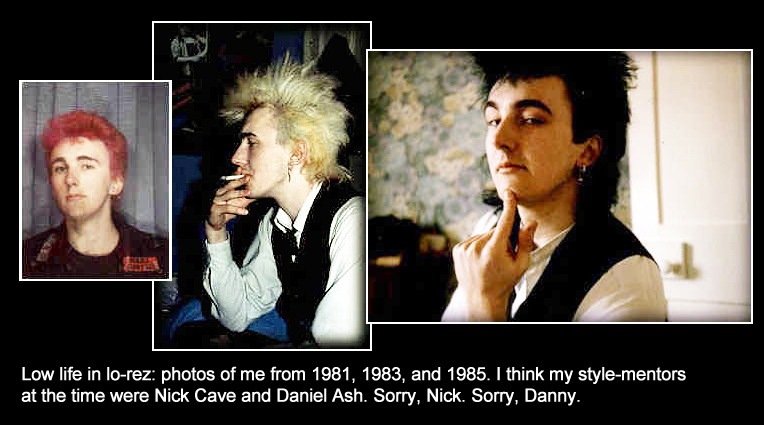 |
Kicking around London in the early 80s, going to gigs
at the likes of the Lyceum, the Hammersmith Palais, the Clarendon and the
Marquee, I saw the early heroes of post-punk in the first flush of their
success: Siouxsie And the Banshees with John McGeoch on guitar (the best line-up),
the old-school, funky, Killing Joke, and scratchy, amphetamine clatter
of the Sisters Of Mercy before Wayne Hussey showed up and slowed 'em
down.
I saw the Virgin Prunes getting bottled off stage by an outraged crowd when they supported Theatre Of Hate. I was down the front for Bauhaus, Ausgang, Southern Death Cult, and UK Decay. I was moshed and squashed at gigs by The Cramps and The Damned; I got my art-rock mojo on with Danielle Dax, Jah Wobble, Cabaret Voltaire, 23 Skidoo, and Lydia Lunch. I even saw Shriekback a few times.
I saw Sonic Youth when they were no-wave weirdos. I saw Hole before Courtney Love became an all-purpose rock celeb (I got a letter from her in which she advises me to 'fuck off and do something with your life!'). I saw Babes In Toyland supported by an unknown punk singer from Dorset called Polly Harvey. I even saw U2, when they were just another band on the alternative rock circuit. I thought they were ridiculously overblown pompous rubbish - and I was right about that, wasn't I?
I stuck my head into the bass bins of the Tackhead Sound System. I flailed foolishly on the dancefloors of the Torture Garden and Slimelight. I built up a large and haphazard record collection - everything from the Shop Assistants to the Bassheads. I've put in time at techno clubs under the Westway and indie pubs in Camden. By the time the twenty-first century rolled around, I was lurking in murky rock 'n' roll basements in the East End of London - and listening to Tom Ravenscroft on BBC 6 Music. Plus ça change, eh?
The Showbiz years
I suppose it was inevitable that I would end up putting on gigs myself. That was in 1995. Things snowballed. Somewhat to my surprise, Nemesis Promotions (there it is: my Shriekback-inspired trading name) became one of London's principal promoters in the goth/industrial and related areas. In fact, at one time, I was the only such promoter in town. Strange to think of it now, when every other person in that particular milieu now seems to be a promoter of some sort. Once, there was only me.
Faith & The Muse, Switchblade Symphony, London After Midnight, and Project Pitchfork, among others, made their London debuts at my shows. 90s heroes such as Rosetta Stone, Manuskript, and Children On Stun were regular stars. Dream City Film Club brought their low-life angst to my stage. Sunshot shot it up. I booked Clan Of Xymox for the first time in the UK for over a decade. I booked Covenant when they were obscure and cheap. Their manager mentioned the band's fee and I had to bite my tongue to stop myself from exclaiming, "Is that all?" I was probably the last UK promoter to get the band at a bargain price. Lovely chaps, even though they turned their noses up at the Aldi own-brand cola I'd given them on the rider. They wanted the real thing!
Unfortunately I don't believe any videos actually made at my gigs exist. Back in the 90s, video was big science. But here are a couple of my stars, with their own visuals. This is what we'd groove to, back then... On the right, Switchblade Symphony perform 'Clown' - and inadvertently invent Witch House ten years early. It's interesting to speculate that if Switchblade Symphony formed today, they'd fit in neatly somewhere between Lady Gaga and Esben and the Witch, and they'd probably be hailed as the coolest thing in town. We were so far ahead of ourselves back then - and we didn't even know it. |
And on the left, Dream City Film Club perform 'If I Die, I Die' - although this version isn't the original. For the first, rather more punk rock rendition of the song, track down the earlier recording, released on the band's debut EP on the Organ zine's label, Org Records. It's got lots of loud and fearsome guitars, which is what we like around here. But this version has a certain campfire spookiness. We like that, too. Both Switchblade Symphony and Dream City Film Club have now split. Tina Root, Switchblade Symphony's vocalist, subsequently formed TreLux and Small Halo. Michael J Sheehy, vocalist with Dream City Film Club, now performs solo and as part of Michael J Sheehy And The Hired Mourners. |
In my years as a promoter I ended up doing a bit of every rock 'n' roll job you can think of - from tour management to humping gear, from ordering ticket print runs to sorting out the backstage catering. One minute I'd be on the phone booking hotels; next minute I'd be up a step ladder, fixing the lighting rig.
I became quite an expert on the arcane minutiae of rock 'n' roll logistics, such as splitter van hire and backline set-up. I could discuss in geeky detail the merits of Volkswagen Transporter and Ford Transit splitter vans, or Ampeg and Trace Eliot bass amps. I learned to dislike the Ampeg SVT-810 8x10 cabinet - great sound, but it's a huge and heavy lump. And it always seemed to be me who had to carry the bloody thing up the stairs...
At one time I was even registered at the Department Of Employment
as an employer, so I could obtain UK work permits for bands from outside the
EU. But my veneer of professionalism was very thin. It was often crazy chaos
behind the scenes.  I don't think any of my bands actually threw TV sets out
of hotel room windows, but it came pretty close once or twice. It did occur
to me several times over the years I spent as a promoter that my life had turned
into 'Spinal Tap: The Goth Years'.
I don't think any of my bands actually threw TV sets out
of hotel room windows, but it came pretty close once or twice. It did occur
to me several times over the years I spent as a promoter that my life had turned
into 'Spinal Tap: The Goth Years'.
I like to think my showbiz career was an artistic triumph, although frankly it was a financial disaster from first gig to last. Being a promoter of live music at a time when club culture was on the rise was really just an extended exercise in shovelling money into a bottomless pit. And getting involved with goth stuff at a time when the media at large didn't want to know was a masterpiece of bad timing.
Things are different now, of course. The music biz has come round to the idea that bands with a little something of the night about them are actually rather cool, and live music has come into its own again.
Maybe, in a small way, I helped to nudge things in that direction. I certainly carried a spluttering torch for loud, weird, live music at a time when it definitely wasn't fashionable to do so.
It's interesting to speculate that if I'd opened a dance-around-your-handbag
club night at the time, I would probably have made a mint. The club nights
which ran at the Underworld after my gigs kicked out were always rammed,
and with no bands to pay the promoters must've been coining it. I had much
greater overheads - and a distinctly niche audience. No wonder I've got
a hole in my bank balance to this day.
Stepping sideways
In 2001 I decided to step sideways. On and off over the years, I've contributed words, photographs, and sometimes even cartoons to assorted music publications, from obscure fanzines to relatively mainstream mags - although, curiously enough, I never had a zine of my own until I started this one.
Getting back into the world of rock 'n' roll words and pictures seemed like a natural move, especially as the web now means that non-mainstream music writing has greater reach and clout than ever before. A heady prospect for anyone who, like me, compulsively holds forth about music at a moment's notice.
Between 2002 and 2005 I contributed reviews and photos to the US webzine StarVox - now closed and defunct, but thanks to the Wayback Machine web archive much of my stuff is still out there if you'd like to read it. In fact, as the StarVox archives show, I ended up writing the bulk of the content, certainly as far as live reviews were concerned.
In the end I realised it was rather silly for me to more or less carry a zine which ultimately belonged to someone else. So, in 2006 I opened up my own rock 'n' roll takeaway, Nemesis To Go. You're tucking in to it now.
Getting in on the ground floor
I'm quietly proud of the fact that my webzine scooped
the mainstream music media on many occasions, getting in early with
bands that only later gained wider recognition.
I was covering
bands such as An
Experiment On A Bird In The Air Pump, Ipso
Facto, Romance, Ulterior, O.
Children, These
New Puritans,
and S.C.U.M anything
up to three years before Big Media paid any attention (or, in the case
of Ulterior, before they became the latest sensation on the Deutsche schwarze
szene). I reviewed, photographed and interviewed Tying
Tiffany three years before the NME
discovered her and her soundtrack side project made
music for The Hunger Games. I was at the very first
Zola Jesus gig in
the UK, and did one of the first - if not the very first - UK interviews with
her. Even Slaves and Fat
White Family, both currently enjoying their fifteen minutes
of fame as the mainstream media's token noise
boys, got early coverage right here.
My Emilie
Autumn reviews and photos follow her
progress from a pub
function room in Ilfracombe to the Shepherd's
Bush Empire in London. Not a bad trajectory, especially for
an artist who relies on a cult following. Emilie's cult has grown, and
so has her media presence: she now gets full-page features in
the likes of Kerrang! magazine. But I've been with her
all the way, and told the whole story as it happened. Kerrang! never showed
up to that pub function room in Ilfracombe, let's put it like that.
(I did once try to
interview Emilie Autumn, because the frustrating thing about her
usual interviews is that nobody ever asks the interesting questions.
Emilie herself was perfectly willing, but the multiple layers of music
biz middle-men who surrounded her at the time, some of which I suspect
she didn't even know existed, conspired to kick the idea into the long
grass. They never said no, but I discovered they had a million ways of
saying "Yes, but....")
I was reviewing Savages as
an obscure support band long before they became the new mainstream sensation.
I also covered pre-Savages bands John
and Jehn and Partly
Faithful - the latter mysteriously absent from official
biographies (music biz middle-men
at work again there, I suspect). The bits of the Savages story that
were edited out of the authorised version can be found in these pages.
Even Artrocker magazine, which could usually be relied
upon to scuttle in the door before the NME had got out
of bed, ended up following me at a safe distance. Artrocker's November
2011 Artery interview covered almost exactly the same ground as my
Artery interview - of two years previously. Do try
to keep up at the back.
Perhaps the most surreal example of my tendency to get in first came when
The Courtesans -
a band I'd reviewed and photographed in 2007 and 2010 - ended up as a wild
card entry on
the X-Factor in 2014. I didn't call them an 'eccentric duo',
though. If you want to know what I did call them (and also find
any other bands I've covered) you can call up the content using the search
box at the bottom of this page.
Occasionally, I would jokingly tell people that if they wanted to know what
their favourite bands will be in a couple of years' time, just look at the
bands I'm covering now. But then again, I was only half joking, because
that exact scenario has played out on several occasions.
It's not like I thought of myself as Spotting The Stars Of Tomorrow Today.
But it was interesting (and, I confess, rather gratifying) when the world
at large belatedly latched on to a band I'd been championing from their early
days.
It wasn't all about catching stars at an embryonic
stage, of course. Some of the bands I covered came out of obscurity and
vanished straight back there, with only a brief moment above the parapet.
But many of them nevertheless did great things:
made great music, played great gigs, created their own bespoke disturbances
in the force. I was there to see them do it, and record the experience.
Much of the twenty-first century post-punk scene, which was centred around
east London and spread its tentacles all over the UK, played out in these
pages. From the Dice
Club to the Offset
Festival -
I was there. And from Selfish
Cunt to the mighty Manflu -
I saw the bands for the brief time they existed, and surfed on the waves
they made.
Is Nemesis To Go safe for my wife and servants to read?
Ah, it's time for a disclaimer.
Nemesis To Go is not what I would call an 'adult' website. It is not festooned with gratuitous pictures of hawt chyxx (or, indeed, hawt guys) in states of undress - although you might find a few photos of bands in risqué stagewear. However, I do employ the English language in all its expressive glory, without any foolish fig leaves of self-censorship. This means that if I'm moved to say fuck, I'll say fuck - and not f*ck, or f**k, or any other unconvincing 'I'm not really swearing, vicar' version.
Therefore, Nemesis To Go may not be entirely suitable reading matter for sensitive ickle kiddies, or indeed sensitive ickle adults. You must make your own decision here.
Adverts, cookies, and legal small print
As I'm sure you've noticed, I put
adverts on the newer pages of the site via Google AdSense, which automatically
serves up ads based on the cookies on your computer. As a money-making idea
this proved to be a non-starter - a click on a banner ad pays only a tiny
fraction of a penny, and very, very few people ever click.
Pay-per-click advertising only works if you've got a
hit rate in the millions per day. At that level, a tiny percentage of ad
clicks might be just enough to generate a visible income. My hit rate was (and
still is) pretty good, but it was never that good.
I never made a bean out
of the ads, although in other ways I think they helped. They gave my webzine
a professional feel, which I think encouraged music biz people to take me
a bit more seriously on the occasions I asked for photo passes and the
like.
At any rate, the ads remain, for whatever they're worth. And thus I have to
give you a brief burst
of legal small print, because Google AdSense tells me I must tell you this:
This website uses log files to gather basic information about site traffic. These record internet protocol (IP) addresses, browser type, date and time of visit, entry and exit pages, numbers of unique users, search keywords, referring sites and search engines, etc. This information does not identify individuals. No personal information is gathered. I have no way of knowing who you are (although I'm sure you're a lovely person).
Third party vendors, including Google, use cookies to serve advertising on this site, specifically by means of the DoubleClick DART cookie. This enables Google to serve ads based on visits to this site and/or other sites on the Internet. You can opt out of the use of the DART cookie by visiting the advertising opt-out page on the Google website.
Go here - then click the 'Opt Out' button.
You can, of course, also disable cookies in your own web browser. It seems you can also get rid of the ads by disabling Flash, although if you do that other stuff will stop working, too.
It's also worth noting that I am not responsible for the content of external links. If you follow a link from this site and discover something that fills you with seething disgust, existential woe, or otherwise gets you wailing and gnashing your teeth, don't come moaning to me, cuz it ain't my fault.
Why did Nemesis To Go stop?
The short answer is, quite simply, because it was taking up too much time.
The magazine-style format, which would have been appropriate if my original
plan of presiding over a merry crew of contributors had come about,
proved to be a lot of work to maintain for just one person's output.
And there was a lot of output. Any other publication which produced
a similar quantity of content would employ several people
to do what I ended up doing single-handed. Writers, photographers, editors,
sub-editors, IT people - it would be a team effort, and I discovered that trying
to do it all as a team of one was a bit too much.
In particular I hit a problem in early 2014 when my hard drive died a horrible
death, just at the time I was getting ready to upload issue 14. Fortunately,
I didn't lose everything. Unfortunately, I did lose some things, and trying
to haul everything back on track was a lot of extra time-consuming work on
top of all the usual time-consuming work - time I didn't really have to spare.
That's why issue 15 (uploaded September 2014) ended up as a double issue, with
the content of the missing issue 14 shovelled in there, too. It was the most
painless method of getting everything up and running again, and it wasn't even
all that painless...
While I managed to get
things sorted in the end, the sheer amount of work involved, and the
time it took, made me think that maybe I should quit under controlled conditions
while I was at least slightly ahead.
After all, running Nemesis To Go was never going to get any easier...while
it might well end up getting more difficult.
So, the double issue of Nemesis To Go 14/15 is the
last. But that doesn't mean you've seen the last of me.
What comes next?
I'm not entirely sure. But I'm sure I'll think of something!
I may start up a conventional blog for my music-related writing and photography.
Rolling updates, added to at regular intervals, one thing at a time, is
likely to be a much easier format to keep up to date. It's probably an
easier format for casual readers to dip into, too. There's also my Mixcloud radio
station, which I set up in a burst of over-optimism some time ago - and then,
inevitably, never had time to work on. So there are possibilities. Watch
this (or that, or the other) space...
Meanwhile, you can keep up with me on Facebook, and send
me emails here.
Nemesis To Go will remain online, and will even receive a few tweaks and
improvements in the future - I still have some behind-the-scenes
tidying up to do in the aftermath of my hard drive crash.
Please dig into
my back pages,
look at the photos,
and read the older material voraciously. If I say so myself,
there's good stuff in there, including quite a bit of 'before they were famous'
coverage of artists who later went on to bigger things. You'll also find many
bands who might not ever have become megastars, but which were (and are) doing
great things on their own terms.

To be continued (somewhere else)...
 Words and photos in Nemesis To Go by Michael Johnson are licenced under