


Email | LiveJournal | MySpace | Last FM

Wave Gotik Treffen 2009
 Day
3
Day
3
Bands
in order of appearance:
Noctulus
Fetisch:Mensch
Vendemmian
Lacrimas Proundre
Fliehende Stürme
Umbra Et Imago
Peter
Murphy
Agra,
Leipzig
Sunday May 31 2009
Back to the Agra, a venue at which I seem to be spending an unfeasible amount of time at this particular WGT. In previous years I've spent much of the festival chasing bands from venue to venue, but this year the schedule is against me. Today, there are other bands I'd like to see in other places, but no realistic way of making the journeys between the various locations in time to see everything. The Gruftiebahn is good, but it's not that good. So, more in a spirit of cutting my losses than anything else, I've elected to give the Agra another go.
A strange man is wandering around the stage. Occasionally, when he remembers, he strikes at a guitar. Effect-laden noise fills the air. The strange man adresses us in a sepulcheral voice of doom. This is greeted with good-humoured cheers by a crowd that's surely bigger than it would normally be for an opening act. That's because the strange man is Noctulus, the WGT's very own space-rock busker, who has become a fixture over the years at his pitch just outside the Agra. Finally, they've let him inside.
Unfortunately it must be said that Noctilus doesn't really rise to the occasion. He's been awarded a slot on the festival's biggest stage, a prize many bands would sell their grannies to win. And yet all he does is goof around. It's quite fun to watch him goof around for about five minutes, but the novelty swiftly wears off. Alas, unlike his normal busking performances, it's not possible to walk on by.
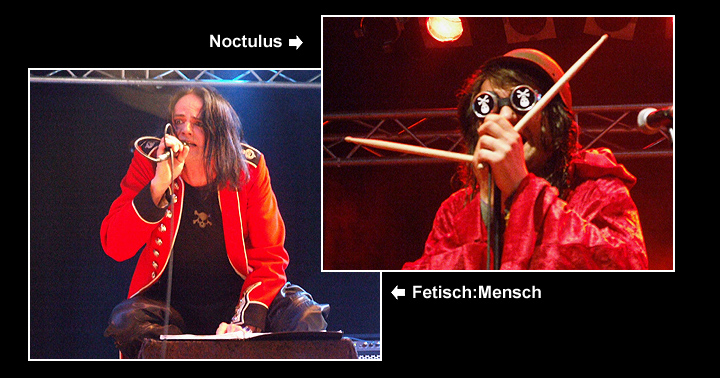
Our first proper band of the day, Fetisch:Mensch, arrive on stage mercifully quickly. The quality of this mercy turns out to be a little strained, however, beause there doesn't seem to be anything particularly fetishistic about Fetisch:Mensch. They seem like an entirely straightforward bunch of gothic rockers to me. The vocalist declaims dramatically from atop a big black box on stage, looking like a magician who's lost his glamourous assistant. Aside from this mildly diverting element, the band's show comprises chunky old rock songs all the way, played with robust competence but little in the way of excitement. This is a band full of solid virtues, for sure, but for me they're too much Mensch and not enough Fetisch.
Yesterday, at the Felsenkeller, I wondered if the Germans were under the impression that the only think the UK is good for these days is rehashed 80s bands. Well, of course, I was just shooting the breeze there. I know that's not true at all. The Germans also regard the UK as a useful source of rehashed 90s bands.
By way of illustration, here's Vendemmian, a band which originally came to the fore in the mid-90s UK goth scene. This was the period when the major goth bands of the time - the Sisters, The Mission, the Nephilim - had more or less coasted to a halt, and the British music media had begun its long-standing antipathy to anything that even hinted at the G-word. The only option for the diehards was DIY. A new goth scene bootstrapped itself up out of the underground - bands, festivals, fanzines, the whole works. It was a case of making a virtue out of necessity at the time, but over a decade on, the DIY British goth scene of the 90s now looks kinda cool - at least when viewed from Germany. Certainly Vendemmian, reformed and with a new album on release, suddenly find themselves contenders for the biggest stage at the WGT, a slot that was never on offer first time round. Now there's an irony.
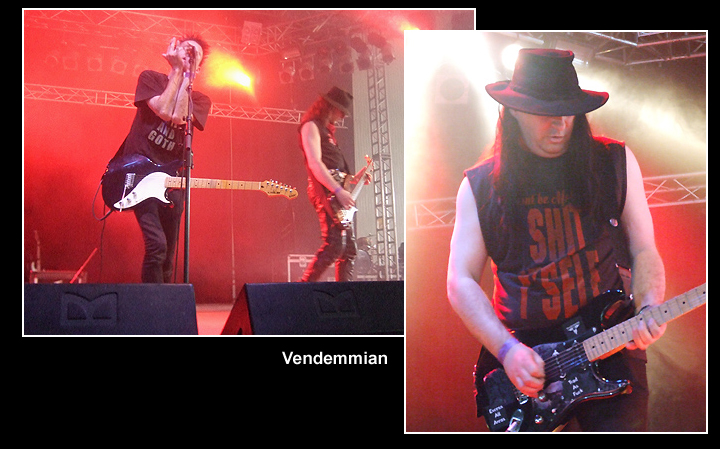
You can always tell when a British band is on stage at the WGT. There's a sudden decrease in the amount of backline, and a sudden increase in the number of hats. The three members of Vendemmian, two thirds hatted-up in the approved manner, position themselves at strategic locations on a near-empty stage, with only miniscule amps to mark their territory. The programmed drums rattle and clatter, as if the band's songwrting technique begins with a firm prod on the 'fast goth' preset button. The guitar sweeps in, the bass gives it that push-push-push thing, and Mark the vocalist, a guitar hanging round his neck like a hardware cravat (he hardly ever touches it: he's wearing it as an item of clothing more than an instrument) lets rip with an impassioned yell.
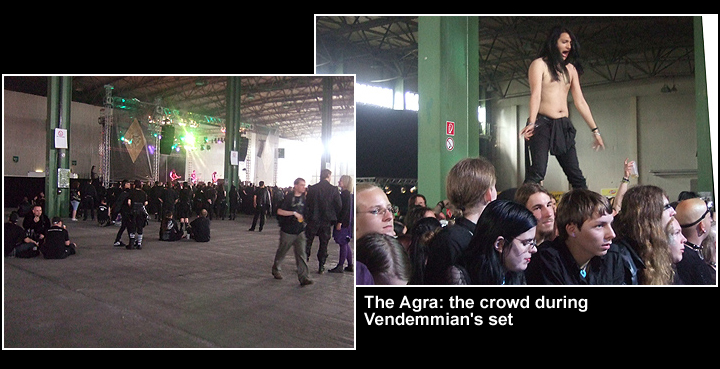
It must be said that the ingredients of Vendemmian's sound are pretty typical of yer actual 90s British goth band, but here in the twenty-first century that gives them an identity that perhaps they never had first time round, when it seemed like every band on the block was making a minor variation of the same racket. At any rate, there's a crush of fans down the front, and while the Agra is not exactly rammed, there are probably more people here than the band ever played to at their gigs in the 90s. The fans make up in enthusiasm what they lack in numbers. Someone gets up on the crowd's shoulders, and rocks out precariously from on high, and for a moment you'd almost think it was the Marquee in 1996 again. Personally, I'm not sure if I want to go back there, but many people in this crowd have no such doubts.
It's translation time again. Being a product of the British comprehensive school system, my classical education never quite got off the ground, but as far as I know the name of our next band, Lacrimas Profundere, is Latin for 'to shed tears'. Well, I certainly don't know whether to laugh or cry.
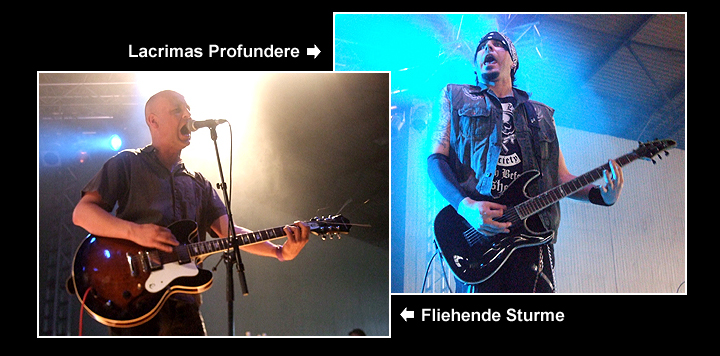
Lacrimas Profundere are a one-band amalgamation of everything that is cheesy and self-parodic about rock music. They're a compendium of clichés, from the self-conciously 'rawk' on-stage moves, to the identikit anthemics of their songs. It's as if they went to see This Is Spinal Tap, and assumed the movie was an educational film rather than a pisstake. I'll give 'em this, though: they're not quite as embarrassing as The 69 Eyes, but they're certainly working from the same recipie for rock 'n' roll cheese sauce. The audience, which has obviously suspended its collective sense of irony for the duration, loves every hackneyed powerchord.
Now, here's an observation - and possibly a tactless thing to mention, but what the hell. I get a slight impression that the WGT is struggling a bit to find sufficient quantities of A-list bands to fill its bills this year.
Maybe we shouldn't be surprised at that, for the Euro-festival circuit seems to get bigger every year, with more events and bigger events all competing to grab the best contenders from what is, after all, a limited pool of artists. With events such as M'era Luna, Woodstage, Amphi, Dark Dance Treffen, Castle Party, Judgment Day and umpteen more going for broadly the same range of bands, it's a matter of simple logistics that it'll become difficult to keep the must-see factor up.
Maybe that's at least part of the reason why the WGT has gone so heavily for the British bands of yesteryear option. Maybe that's why the advance festival publicity didn't list a headliner for the first day at the Agra until the late booking of Project Pitchfork filled the gap. It's interesting to speculate what would have happened if Pitchfork had said no - could've been the Scary Bitches' big chance! The band-shortage could even be the reason why Noctulus, the Agra space-rock busker, was given a spot on stage this year - after all, it's one less real band to book. And, all due respect to Fliehende Stürme, it might even be why an 80s punk band, almost completely unknown outside Germany, is on stage now, mid-bill at the WGT's biggest venue.
Fliehende Stürme (it means 'Fleeing Storms', translation fans) have a history that goes back to 1983, when the band mutated out of an earlier hardcore outfit. They have a reputation for playing 'dark punk', it says here, which is all well and good, although to my ears the band simply plays...punk. And for sure they're not bad at it. They knock out some no-shit riffs with an admirable absence of fuss, and certainly no gormless grandstanding, which is a distinct relief after Lacrimas Profondere.
But Fliehende Stürme are nevertheless an oddity at the WGT, which, notwithstanding the punk influences exhibited by many of its bands, seldom takes an excursion all the way into the punk zone. I can't think of a time when the festival has ever given a purely punk band such a high profile slot.
I have to conclude that the situation is really the result of this year's band shortage. It's an ill wind that blows nobody any good, of course, and Fliehende Sturme would've been silly to turn down the opportunity to get on a big stage at a big event. But their presence says more about the logistics of running a festival than it does about the band.
 Up
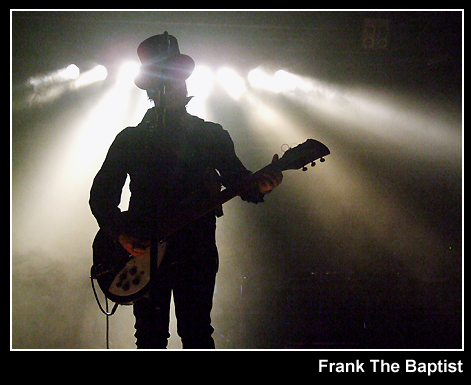
to now I think the only times I've seen Frank
The Baptist play, it's been at some sort of deathrock gig,
or festival, or indeed the deathrock day here at the WGT. That's been
a source of frustration for me, because I've always held the view that
Frank The Baptist has great potential beyond that small genre. The band
could easily make a mark in the wider world of indie-alternative-post-punk-whatever,
but in order to get there it will first be necessary to disengage from
the deathrock mothership.
Up
to now I think the only times I've seen Frank
The Baptist play, it's been at some sort of deathrock gig,
or festival, or indeed the deathrock day here at the WGT. That's been
a source of frustration for me, because I've always held the view that
Frank The Baptist has great potential beyond that small genre. The band
could easily make a mark in the wider world of indie-alternative-post-punk-whatever,
but in order to get there it will first be necessary to disengage from
the deathrock mothership.
Well, today it seems Frank The Baptist has made a first step in the direction of disengagement. Mixing it on the WGT main stage with the punks and the gothic rockers may not amount to a huge leap into the unknown, but at least we're not in deathrock lockdown any more.
Standing centre-stage, toting his traditional hat and Rickenbacker, Frank himself cuts an instantly recognisable figure. He's the chimerical troubadour ready for the carny to begin. The band strikes up that bold, wide-screen sound that so neatly counterpoints Frank's lyrical stories of love and loss, calamity and celebration. It's a fine show; the band seems entirely at home on the big stage, and the audience, by no means the usual Frank The Baptist barmy army, is swept along.
Trouble is, they're not swept along for very long. Time, it seems, runs out. A crew bod walks out on stage, making cut-it gestures. And that - suddenly, abruptly - is the end of the set. No 'just one more'. It's over. Not the way Frank planned it, that's for sure - and not what the audience wanted, either.
 I
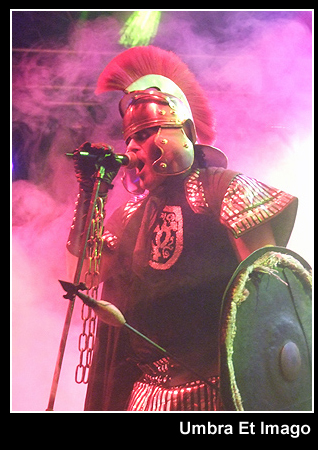
recall catching Umbra Et Imago in
the Agra back in 2005, where their schtick - basically, wacky costumes
and assorted fetish high jinks to a soundtrack of pummelling metal - provided
a pantomime-style finish to the evening. This year, the band is back.
So are the costumes, and so are the fetish high jinks. Umbra Et Imago
clearly haven't gone off an any artistic tangents since I last saw them.
Their show is entirely familiar. If it ain't broke, don't fix it, right?
I
recall catching Umbra Et Imago in
the Agra back in 2005, where their schtick - basically, wacky costumes
and assorted fetish high jinks to a soundtrack of pummelling metal - provided
a pantomime-style finish to the evening. This year, the band is back.
So are the costumes, and so are the fetish high jinks. Umbra Et Imago
clearly haven't gone off an any artistic tangents since I last saw them.
Their show is entirely familiar. If it ain't broke, don't fix it, right?
Frontman Mozart (possibly no relation) cuts a large and looming figure in his Roman centurion outfit, although the dramatic effect of the costume is somewhat diminished early in the set, when he takes his helmet off and reveals the balding, tubby rock bloke underneath. That's the thing about Umbra Et Imago: their music is entirely conventional metal, and underneath the image the people in the band are entirely conventional metal musos.
The band's unique selling point is all in the dress-up element - and the hawt chyx in skimpy costumes, who enact full-scale dungeon dramatics as the band rumbles along. But if we were to put Umbra Et Imago in the laboratory and remove these elements from the compound, I think we'd find that what's left is nothing more than the inert bulking agent of very ordinary heavy metal. The crowd sucks up the spectacle - and, undoubtably, it is a spectacle - but I can't help feeling that there's not much substance underneath.
A
few years back I saw ASP play to a
hundred-odd Brit-goths in a hotel ballroom in Leeds, courtesy of the Black
Veil festival. I think that's the only UK gig the band has ever played.
I mention this because I now realise how unusual that gig was - for in
Germany, ASP are massive. The Agra fills to capacity and beyond
as the band's showtime approaches. They're far and away the biggest draw
I've seen at the WGT this year, or, I think, any year. In a way I can
understand the band's appeal, for frontman Alexander Spreng (he who is
ASP) is a consummate showman, a maverick figure in spooky 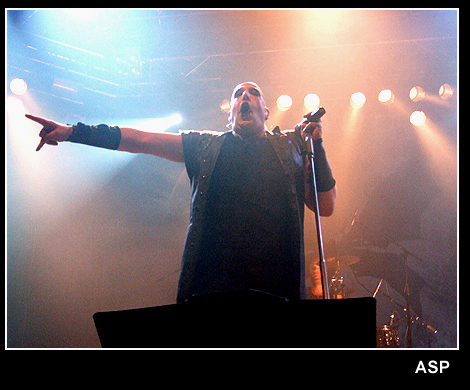 makeup.
He leads the band's charge from the front with a gale-force bellow of
a vocal, a vast repertoire of grand gestures - and plenty of pyrotechnics,
to boot.
makeup.
He leads the band's charge from the front with a gale-force bellow of
a vocal, a vast repertoire of grand gestures - and plenty of pyrotechnics,
to boot.
But the band's music, which always veered towards conventional pomp rock, has now become so hugely bombastic it's like standing in the way of a heavy metal avalanche. Every song is a fist-in-the-air anthem, and that's obviously the stuff this multitude wants to hear.
A little bit of bombast goes a long way with me, though, so I force my way through the crush, which extends all the way to the very back of the hall, and head for the toilets outside. But even here - outside the venue - there's a large crowd of ASP acolytes, peeking in the door to see the band on stage, easily sixty metres or more away, and enthusiastically rocking out even at this distance. ASP's massive popularity is quite a phenomenon, although as far as I can see it doesn't extend much beyond Germany. If the band played another UK gig I suspect they'd be down to a hundred-odd goths again. Here in Leipzig, several thousand bombastic metal fans put us in a very different place.
It's Mittnacht Spezial time again - which means we've got to wait, and wait, and wait until some unspecified hour of the early morning, until, at last, Peter Murphy starts his show. It's ironic that Frank The Baptist suffered an abruptly truncated set due to the strict timings earlier in the day, yet as soon as we get beyond midnight any notion of a schedule seems to go out of the window. At any rate, Pete takes his own sweet time in arriving on stage - but fortunately, when he finally turns up, he makes the wait worthwhile.
It's immediately obvious that Peter Murphy and his band have eschewed full-on gothicisms - which, on the face if it, you might expect when the godfather of goth (sorry, Pete, but you are) plays at a goth festival. But no, the look of the band is post-punk glam, and the first few songs are new, previously unheard, solo stuff. While the new songs seem to be full of robust rock 'n' roll qualities, it must be said they don't seem particularly distinctive at first hearing. We'll come back to those, then.
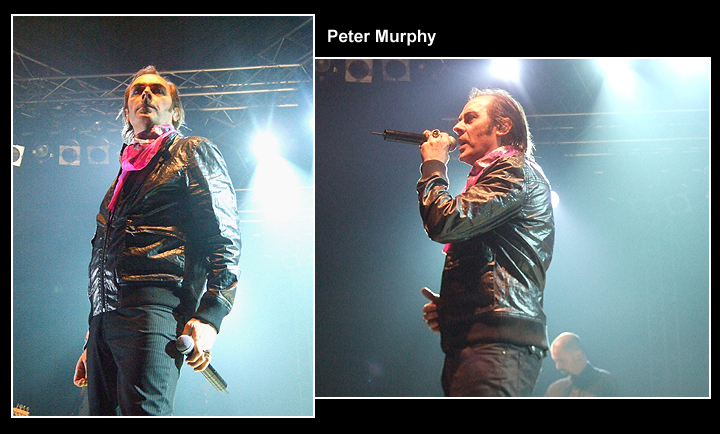
It's a relief when the band swings into the main part of the set, and we're reminded of just how good Peter Murphy can be. The band seems to shift up a gear as they rattle through the back catalogue of both Bauhaus and Peter Murphy's earlier solo stuff. 'Burning From The Inside' is high-tension electricity trapped in the form of a song; 'She's In Parties' is as nimble as ever, and 'The Passion Of Lovers' is all slash and burn.
It's a little odd for me, watching Peter Murphy, now the respected elder statesman of alternative rock, delivering these classic oldies with such magisterial authority. Back in the 80s, at such London venues as the Lyceum and Hammersmith Palais, I remember watching another Peter Murphy, the skinny young glam-punk from Northampton, ripping these songs out amid the theatrical chaos of a Bauhaus set, when they were new and like nothing we'd heard before. I can't help wondering how many people here in the Agra have that same perspective. The Bauhaus numbers still have all their presence, and Peter Murphy delivers them with plenty of panache, but there's no escaping the fact that we've come a long way from there to here. The older solo songs, which don't have quite so much artistic distance behind them, work well, too - in particular, 'I'll Fall With Your Knife' is fully loaded with classic Murphy dramatics. That old glam-punk's still got it, you know.
Out in the crowd Pete spots Eddie Branch, his old bassist, here in Leipzig to perform with his original band UK Decay, and says a hasty hello - a rare departure in this performance from his purposeful between-song taciturnity. The grand finale is a bafflingly theatrical recitation of David Bowie's 'Space Oddity', in which Peter Murphy paces the stage, a feather boa around his neck, intoning the words to a backing track. The band come on, but they don't play. They simply lie down on stage...and the show eases to a close. 'Leipzig is blue,' remarks Pete, gnomically, 'And I say auf weidershen to you'.
In the crowd, someone asks Eddie Branch what he thought. 'It was all right,' he replies, cautiously. All that and more, Eddie. All that and more.
Essential links:
Noctulus:
MySpace
Fetisch:Mensch:
Website | MySpace
Vendemmian: MySpace
Lacrimas Proundre: Website | MySpace
Fliehende Stürme: Website
| MySpace
Frank The Baptist: Website
| MySpace
Umbra Et Imago: Website | MySpace
ASP: Website | MySpace
Peter Murphy: Website | MySpace
Wave Gotik Treffen: Website | MySpace
Continue to the Wave Gotik Treffen Day 4 here.
Back to the Wave Gotik Treffen Day 2 here.
For more photos from the Wave Gotik Treffen, find the bands by name here.
Email | LiveJournal | MySpace | Last FM
Page credits: Review,
photos and construction by Michael Johnson.
Nemesis
logo by Antony Johnston, Red
N version by Mark Rimmell.